|
|
|
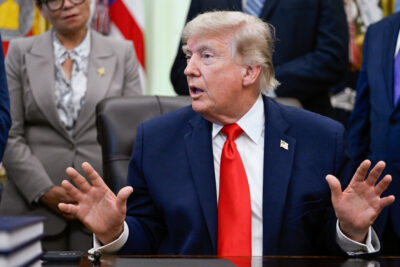
Trump Postpones Next Round of Bombings, Says Iran Deal ‘Approved’
|
Iran has not echoed that same word publicly. First, from the President: Based on the fact that discussions with the Islamic Republic of Iran have been brought to the highest level of Iranian leadership and approved, I have, as President of the United States of America, cancelled the scheduled strikes and bombings against Iran this evening…. The Naval Blockade will remain in full force and effect until this Transaction is finalized—Time and place of the signing to be announced shortly ( Truth). Barak Ravid at Axios: Trump has claimed an agreement was close multiple times before, and Tehran said in response to Trump’s latest claim that there had been no “final decision.” However, three sources briefed on the talks told Axios that key gaps were narrowed during talks between Iranian officials and Qatari mediators on Wednesday. Iran’s Fars news agency denied any deal had been agreed, but said there was a “possibility” Tehran would consider signing off…. Negotiations continued late into Wednesday night in Tehran as Qatari envoy Ali Al-Thawadi and Iranian Foreign Minister Abbas Araghchi worked to bridge the remaining gaps between the U.S. and Iran. According to three sources briefed on the talks, the Qataris and the Iranians believed on Wednesday that they had reached an agreed-upon text that the U.S. would also accept ( Axios).
|
|
|
|
|
|
Six Essential Requirements for a Good Iran Nuclear Deal
|
From the folks at the Foundation for Defense of Democracies who have invested years in the Iran project. This: abbreviated from Andrea Sticker: 1. Iran must support full recovery by the United States, the IAEA, or an international team of all 9,000+ kilograms of enriched uranium hexafluoride (UF6), including 440 kilograms of highly enriched uranium (HEU). 2. Iran must accept destruction of its enriched uranium stocks — or that access and use is limited strictly to legitimate civilian technical needs. 3. Iran must accept a permanent ban on uranium enrichment and plutonium reprocessing. 4. Iran must accept full and permanent dismantlement, export, or in-place destruction of its uranium production and enrichment infrastructure, including all related facilities, centrifuges, components, and centrifuge manufacturing capabilities, and plutonium production and separation assets. 5. Iran must make a complete, accurate, and comprehensive declaration of its entire nuclear program — including all past nuclear weapons-related work, sites, activities, and assets — and agree to a verified termination of any weaponization efforts, and an IAEA mandate to assess the correctness and completeness of the declaration. 6. Iran must restore IAEA access and permit “anywhere, anytime” IAEA inspections — including at military sites when required — along with full access to equipment, personnel, and documentation ( FDD).
|
|
|
|
|
|
US Becomes World’s Largest Oil Exporter
|
Overtaking both Saudi Arabia and Russia. Salem News Channel: The shift comes after years of booming US shale production along with disruptions to Russian and Saudi exports tied to war, sanctions, and attacks on energy infrastructure. US crude and fuel exports reached about 10.5 million barrels per day in May, marking the third straight month America has led the world in oil exports ( Salem News Channel). Reuters: America’s ascendancy to the top spot marks a stunning reversal for a country that was dependent on Middle Eastern oil for decades and suffered from an oil embargo imposed by some OPEC members in 1973 to retaliate against U.S. support for Israel. U.S. fortunes began to change after 2010, when oil and gas output from its shale formations soared, first making it the world’s top gas and then the world’s top oil producer…. U.S. exports of crude and fuel climbed to about 10.5 million barrels per day in May on the back of high output and the release of strategic reserves, data from ship tracking services Vortexa showed, making the U.S. the top global exporter for the third month in a row. Russian exports stood at 7 million bpd in May, according to Reuters’ calculations, while Saudi Arabia’s exports stood at 5.9 million bpd, according to Vortexa. In comparison, Saudi Arabia exported about 8.1 million bpd in 2025, while the United States shipped out 6.6 million bpd, and Russian exports stood at about 5.8 million bpd, according to Vortexa data ( Reuters).
|
|
|
|
|
|
Understanding America’s Energy Dominance
|
There’s no question: Donald Trump—over the course of the past decade—has played an enormous part. Indeed, in his first 100 hours this term he announced a plan to ‘unleash American energy’ ( White House). But: None of this unleashing could not have happened without American innovation via the shale revolution. Stephen Moore looks at a new study: Thanks to the shale oil revolution, the United States tripled its oil output in less than 15 years, even as the Malthusian doomsayers (and then President Obama) were assuring us that we would soon be drilling the last barrel of oil on American soil. Shale gas also helped break the back of the OPEC cartel, which, for nearly half a century, had a knife at the neck of the U.S. economy and could, by turning off the spigots, plunge the U.S. economy into a recession. Now a study shows that fracking shale oil and gas have made America rich. The University of California, Berkeley’s Energy Institute at Haas — hardly a right-wing source — has released blockbuster findings on the shale gas revolution: “It may seem like a distant memory now, but as of the mid-2000s, U.S. natural gas production had been flat for a decade, and the U.S. was importing liquefied natural gas (LNG), with plans to import much more. Then shale gas happened. Advances in hydraulic fracturing and horizontal drilling caused U.S. natural gas production to increase significantly, and the U.S. went from being a net importer of natural gas to being the world’s largest exporter. We calculate that U.S. natural gas consumers have saved $3.1-$4.3 trillion between 2007 and 2025, equivalent to $164-$227 billion annually” ( Washington Times).
|
|
|
|
|
|
Today: SpaceX to Start Trading on NASDAQ in Largest IPO Ever
|
Under the ticker symbol SPCX. The company has raised $75 billion in the IPO, with demand for more than four times the 555.6 million available shares which were priced at $135/share. Bloomberg: SpaceX has made history with the biggest-ever IPO, launching it into the top ranks of the largest public companies and putting founder Elon Musk on the verge of becoming the world’s first trillionaire. The company raised $75 billion in the IPO, pricing 555.6 million shares at $135 each, according to a statement on its website Thursday. SpaceX’s IPO is more than double the size of Saudi Aramco’s $29.4 billion listing in 2019…. At the IPO price, SpaceX has a market value of $1.77 trillion. Accounting for employee stock options and restricted share units, the pricing gives it a fully diluted valuation of about $1.8 trillion ( Bloomberg). BlackRock is investing $5 billion, but Elon Musk is looking for and catering to individual investors: Individual investors alone requested well over $70 billion of SpaceX shares, the people familiar with the matter said…. Musk has made it clear from the beginning that he hopes to allocate a larger-than-normal portion, possibly as much as 30% or so, to individual investors ( Wall Street Journal).
|
|
|
|
|
|
Elon Musk: World’s First Trillionaire
|
A fascinating American success story. Wall Street Journal: Elon Musk is poised to become the world’s first trillionaire. His company, SpaceX, is set to begin trading on the Nasdaq Friday. It sold around $75 billion of shares Thursday in an offering that valued Musk’s stake at around $690 billion. When combined with his Tesla holdings and other investments and properties, his net worth surpasses $1 trillion. EV-maker Tesla makes up around $279 billion of his net worth. While he is likely comfortably a trillionaire at SpaceX’s IPO price of $135 a share, his status could change depending on how Tesla and SpaceX shares trade ( Wall Street Journal). Musk is no yacht-owning, vacationing rich man: Musk, of course, is known for sleeping on factory floors and rarely taking vacations. After buying Twitter, he has said, his work exploded to more than 120 hours a week from about 80 hours before. Most of Musk’s wealth is tied up in his companies. He famously said in 2020 that he would “own no house” and sold off several California properties, only to later buy homes in Texas ( Wall Street Journal).
|
|
|
|
|
|
Horror on the Border, I: At Least 146,000 Migrant Children From Biden Open Border Policy Unaccounted For
|
And: A total of 450,000 went missing in the open border madness under the Biden. The announcement came from Homeland Security Secretary Markwayne Mullin, joined Acting AG Todd Blanche. The numbers are horrifying. New York Post: Homeland Security Secretary Markwayne Mullin said Thursday that the Trump administration has found at least 146,000 migrant children that were unaccounted for during the Biden administration. A total of 450,000 went missing under former President Joe Biden — and “nearly 300,000” are still unaccounted for, Mullin said at a news conference. “We’re investigating reports to where some of these kids claim that they were raped 6[00] to 700 times,” he added. “I don’t care who you are. I don’t care if you have kids. You don’t have kids. I don’t care if you’re a liberal, you’re independent, you’re a Democrat. You’re Republican. “If you can’t stand for law enforcement to go find these kids, who are you? Who are you?” Mullin fumed. “And do you know where we’re finding the most of them: sanctuary cities.” Major metropolitan centers like New York City, Chicago and Los Angeles have refused to cooperate with federal immigration enforcement as a result of their sanctuary policies ( New York Post). Mark Wayne Mullin: “It’s shameful that we have governors…[in] sanctuary states that are refusing to allow their law enforcement to join in the 287(g) program where we simply go after the worst of the worst” ( HHS).
|
|
|
|
|
|
Horror on the Border, II: Biden Administration Let in 15,500 ‘Super Sponsor’ Rapists and Pedophiles
|
Where has our shared moral compass gone? Gateway Pundit: The DOJ has identified 15,500 pedophiles, rapists, smugglers, and traffickers that Joe Biden and the Democrats let waltz right into the country and abuse thousands of innocent children. Many of these kids DHS has located have reported being sexually assaulted hundreds of times. In a stunning press conference Thursday, Acting Attorney General Todd Blanche announced federal indictments against three Guatemalan illegal aliens accused of running a sophisticated conspiracy to smuggle dozens of unaccompanied children into America — then delivered the real bombshell that exposes the full scale of the Biden-era child trafficking nightmare. Blanche, joined by Homeland Security Secretary Markwayne Mullin, revealed the indictments of Maritza Azucena Cahuec Coc, her brother Carlos Agustin Cahuec Coc (aka Tuco), and Gladys Marina Caal Chen in the Northern District of Ohio. The trio allegedly used fraudulent sponsorship applications, stolen identities, fake birth certificates, and false claims of being relatives to trick the HHS Office of Refugee Resettlement (ORR) into handing over multiple unaccompanied alien children (UACs). ( Gateway Pundit). Full video of the press event: ( Justice). DHS on Angel Family Marcus and Dalilah Coleman ( DHS).
|
|
|
|
|
|
UK Defense Secretary Abruptly Resigns; Government in ‘Freefall’
|
John Healy accused the Prime Minister of leaving the country unsafe. From his resignation letter: It has become clear to me hat the change I had pushed for is not going to come. Given the situation, I have decided to resign as Minister for the Armed Forces. We face a more unstable and dangerous world than at any point in recent decades, and having spent most of my adult life in uniform, I understand what public service in such a moment demands. It is for this very reason I cannot continue. I have watched, as a Marine, what war looks like now. I have spoken to those who have seen it up close in Ukraine. The lesson is uncomfortable and it is unambiguous. The character of conflict is changing faster than our procurement can keep up with. We are still purchasing capability suitable for the last war while our adversaries arm for the next one ( Healy). Also: Al Carns, the Armed Forces minister, followed him out the door on Thursday evening, accusing the Government of “failing” to defend the country properly. Pamela Nash and Rachel Hopkins also resigned as parliamentary private secretaries to Mr Healey ( Telegraph). And, from GB News: Political Editor at The Independent, David Maddox, discusses speculation that the Foreign Secretary, Yvette Cooper, may resign, saying the government is in ‘freefall’( GB News).
|
|
|
|
|
|
What Is a Woman? Daughters of the American Revolution to Vote on the Matter
|
It’s actually one piece of a potential course correction after leadership changed bylaws in 2023, barring discrimination on the basis gender, sexual orientation or religion. Tyler O’Neill at Daily Signal: The Daughters of the American Revolution currently allows men who identify as women to join, but the group will vote on a resolution to reverse that policy and formally define “woman,” the Daily Signal has learned. “Members of the Daughters of the American Revolution will take an historic vote to define the word ‘woman’ on Friday, June 26, 2026, at Memorial Continental Hall in Washington, D.C.,” Laura McDonald, founder and president of Daughters Advocating for Restoration and a member of Daughters of the American Revolution since 2018, told the Daily Signal. “Daughters all across the country have relentlessly pursued all avenues and have succeeded in their demand for this historic vote,” she added…. “Our founders would never have anticipated men believing they are women would join a women’s only organization,” [Vikki Grieshaber, regent of the Letitia Coxe Shelby chapter in La Mesa, California] explained. “The current membership application has us attest to the fact that we are biological women. We hope to restore our Society to what our founding daughters intended” ( Daily Signal). It would be nice to have DAR restored and ready for the 250 th.
|
|
|
|